

Strategy and Architecture, Continued
Part 1 of this chapter covered Building a Multi-Modal System, Platform Layered Architecture, Stakeholder Involvement, and Cultural and Societal Elements. Now we’ll cover Change Managements, Training and Capacity Building and Success Measures. Part 3 will consider Challenges, and provide an Implementation Roadmap.
GOVERNANCE and STAKEHOLDER Management
Effective GOVERNANCE requires structured processes that balance innovation with responsibility. This balance is particularly crucial in a domain where both technological shortcomings and unchecked advancement can result in serious harm.
Ethical Oversight Committee:
Multi-stakeholder representation including survivors
Regular review of system performance and outcomes
Authority to recommend system modifications
Transparency reporting responsibilities
Data Governance Council:
Clear data ownership policies
Usage limitations and consent management
Privacy protection standards
Data retention and destruction protocols
Algorithmic Accountability Process:
Regular bias testing and mitigation
Performance auditing across demographic groups
False positive/negative impact assessment
Independent verification of system operation
Stakeholder Engagement Structure:
Regular feedback channels from all stakeholder groups
Clear escalation paths for concerns
Collaborative development processes
Transparent decision-making documentation
Each STAKEHOLDER group will have different expectations that must be managed. Managing expectations isn't just about communication—it's about governance structure, implementation approach, and evaluation frameworks. Each stakeholder group brings legitimate but sometimes conflicting expectations that must be harmonized for successful implementation.
Law Enforcement Expectations:
System reliability and evidential standards
Integration with existing workflows
Clear jurisdiction and responsibility delineation
Resource implications for increased early detection
Victim Expectations:
Privacy and security guarantees
Control over their own data and case progression
Realistic expectations about system capabilities
Clear understanding of human vs. AI components
Social Service Provider Expectations:
Workload impact clarity
Resource needs for responding to system alerts
Training requirements and timelines
Performance measurement standards
Community Expectations:
Transparency in system operation
Evidence of effectiveness and fairness
Cultural appropriateness guarantees
Accessibility across digital divides
Change Management
A phased change management program might include:
Phase 1: Foundation Building
Stakeholder mapping and engagement planning
Current state assessment of existing systems
Data sharing agreement development
Initial technology proof-of-concept
Ethical framework establishment
Phase 2: Pilot Implementation
Limited deployment with intensive monitoring
Selected stakeholder training and integration
Baseline data collection for comparison
Rapid iteration based on initial feedback
Governance structure establishment
Phase 3: Expansion and Integration
Geographic and stakeholder expansion
Deep integration with existing systems
Comprehensive training programs
Community awareness campaigns
Continuous improvement processes implementation
Phase 4: Sustainability and Evolution
Long-term funding structure development
Ongoing training and capacity building
System adaptation to emerging needs
Research and outcome publication
Technology refresh planning
Training and Capacity Building
Successful implementation requires an exceptionally comprehensive training strategy due to the sensitivity, complexity, and high-stakes nature of this application. The training strategy should include prioritizing safety and ethics due to the vulnerable population being served. In addition, training must include stakeholder domain specific knowledge integration, context awareness and sensitivity, and multidisciplinary evaluation metrics.
For Technical Users:
System operation and maintenance training
Alert response protocols
Data interpretation guidelines
System limitation awareness
Troubleshooting capabilities
For Service Providers:
Integration with existing workflows
Risk assessment interpretation
Appropriate intervention selection
Documentation requirements
Privacy and security protocols
For Community Members:
System awareness and capabilities
Appropriate usage scenarios
Privacy protection understanding
Feedback submission processes
Setting realistic expectations such as:
Cultural Appropriateness: Systems that respect community values and practices
Accessibility: Tools usable across different languages, abilities, and resources
Community Control: Influence over how systems operate in their communities
Trust Preservation: Technology that doesn't undermine community relationships
Resource Enhancement: Additional capacity rather than redirection of scarce resources
Historical Awareness: Recognition of past institutional harms and traumas
Value Alignment: Systems that reinforce rather than contradict community values
Success Measurement
The development and deployment of this AI system necessitates a comprehensive and multidisciplinary approach to measuring success. Without a robust evaluation framework, the system risks not only ineffectiveness, but also potential harm to the vulnerable populations it aims to serve. The unique ethical implications of AI involvement, coupled with the multidimensional definition of success, the evolving nature of abuse dynamics, the spectrum of stakeholder accountabilities, and the absolute need to prevent algorithm bias necessitate prioritizing the development of a comprehensive, sustainable, agile success measure framework.
Quantitative Assessment
Short-Term Process Metrics:
System accuracy (sensitivity/specificity)
Response time improvements
User adoption rates
Stakeholder satisfaction scores
Resource connection success rates
Data quality metrics
Medium-Term Impact Metrics:
Early intervention rate increases
Reduction in repeat incidents
Service utilization improvements
Protective order compliance rates
Case clearance improvements
Resource utilization efficiency
Long-Term Outcome Metrics:
Reduction in severe violence incidents
Decreased domestic homicide rates
Improved prosecution outcomes
Reduced recidivism
Economic impact assessment (healthcare costs, productivity)
System trust indicators
Generational impact measures
Qualitative Assessment
Beyond quantitative metrics, qualitative assessment should include:
Survivor experience research
Stakeholder perception studies
Case studies of system successes and failures
Community impact narratives
Cultural appropriateness evaluation
Ethical impact assessment
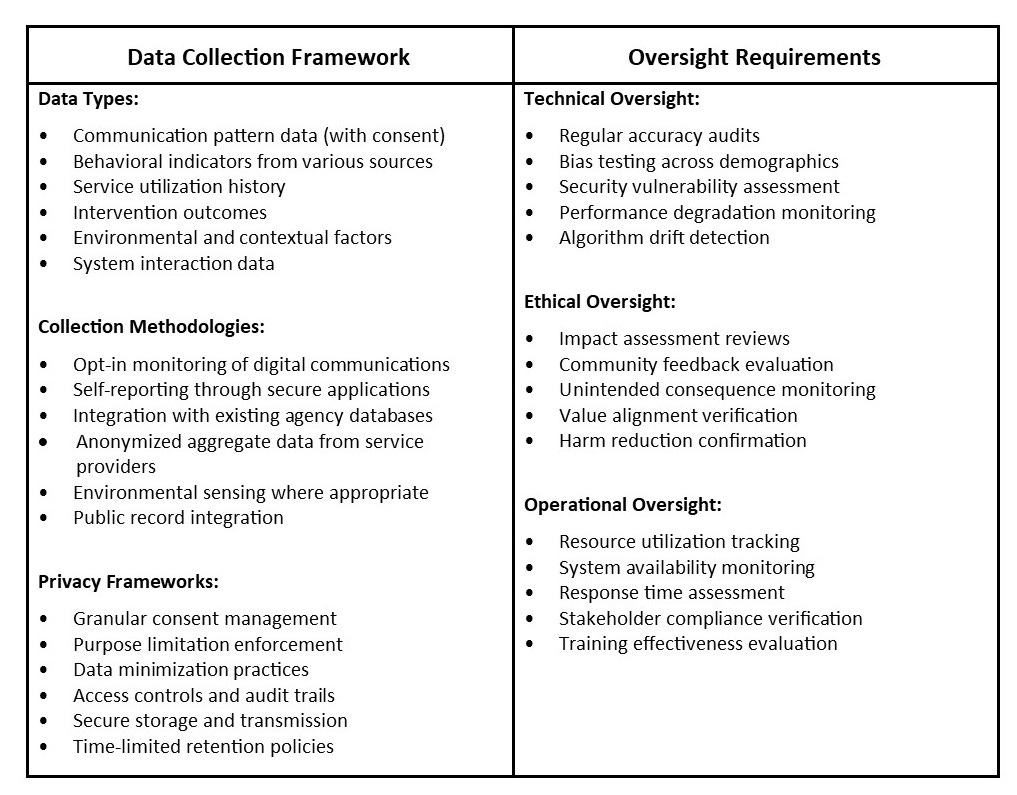
Data Collection and Oversight Requirements
Additional Considerations
Beyond the social, ethical, technical, governance, policy, procedure, data, and stakeholder ownership/alignment considerations, several additional key factors will determine the ultimate success of AI’s contribution to domestic violence solutions. In summary, these would include:
Trust Building:
Demonstrated system reliability
Transparent operation and decision-making
Visible community involvement
Consistent privacy protection
Proven effectiveness over time
Resource Adequacy:
Sufficient intervention capacity
Technical infrastructure investment
Trained personnel availability
Sustainable funding mechanisms
Comprehensive support services
Integration Effectiveness:
Seamless workflow incorporation
Minimal duplicate data entry
Consistent information sharing
Coordinated response protocols
Compatible technical standards
Adaptability:
Evolving threat pattern recognition
Changing social context awareness
New technology incorporation
Emerging stakeholder needs accommodation
Continuous learning implementation
Participatory Evaluation Design:
Success metrics should be developed with input from domestic violence survivors, advocates, and frontline service providers. Their lived experience and professional expertise are essential for creating meaningful measures that reflect real-world priorities rather than technical abstractions.
Ethical Data Collection - Collecting outcome data must be balanced with safety and privacy concerns:
Minimize re-traumatization through careful data collection protocols
Ensure absolute confidentiality and security of sensitive information
Use trauma-informed approaches to evaluation
Offer genuine value to participants in return for their contribution
Provide clear opt-out mechanisms without penalty
Contextual Interpretation - Metrics must be interpreted within their proper contexts:
Lower usage in certain communities might reflect technological barriers rather than less need
Short-term increases in reported violence might actually represent improved disclosure rather than system failure
Successful outcomes look different across cultural contexts and abuse types
Independent Oversight - To maintain objectivity, success measurement should include independent evaluation components:
External audits by domestic violence experts
Ethical review of measurement practices
Transparent reporting of both positive and negative findings
Regular reassessment of the measurement framework itself
Continuous Refinement - The measurement framework should evolve based on:
Emerging research on domestic violence dynamics
Technological developments
User feedback and experiences
Identified gaps or biases in existing metrics
Changes in legal and social service landscapes
Part 3, the final part of Chapter 3, will cover Challenges and provide an Implementation Roadmap.