

Still with us? For those invested in this topic who have been with us from the beginning of the series, this final installment in our third Chapter, Part 3 will cover Challenges and provide an Implementation Roadmap.
Potential Challenges
Implementation will face several significant challenges that underscore the need for uniquely holistic approaches that extend far beyond technical implementation to address the complex human, social, and systemic dimensions involved.
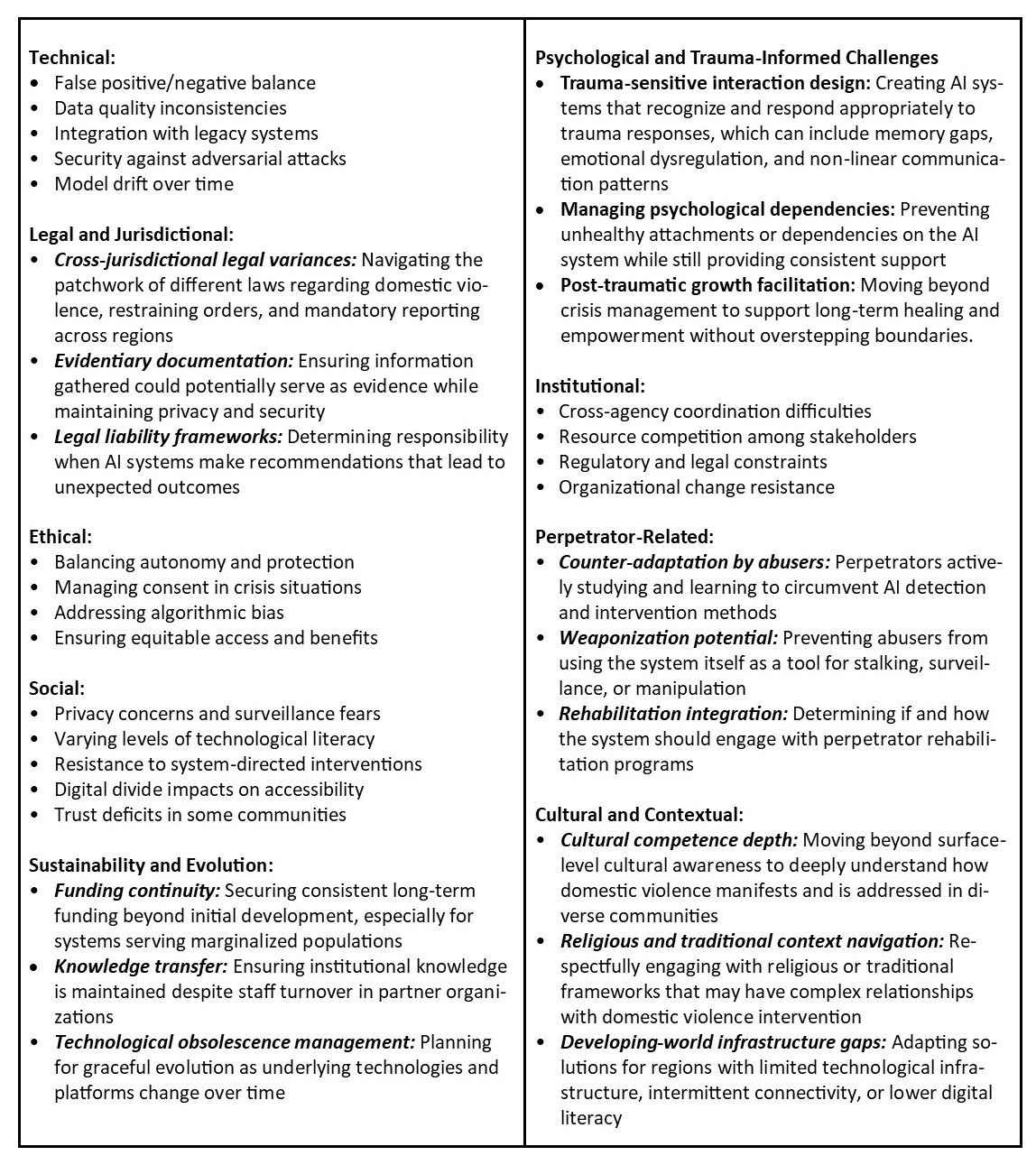
These implementation challenges underscore why domestic violence remediation platforms require uniquely holistic approaches that extend far beyond technical implementation to address the complex human, social, and systemic dimensions involved.
Interdisciplinary Connections
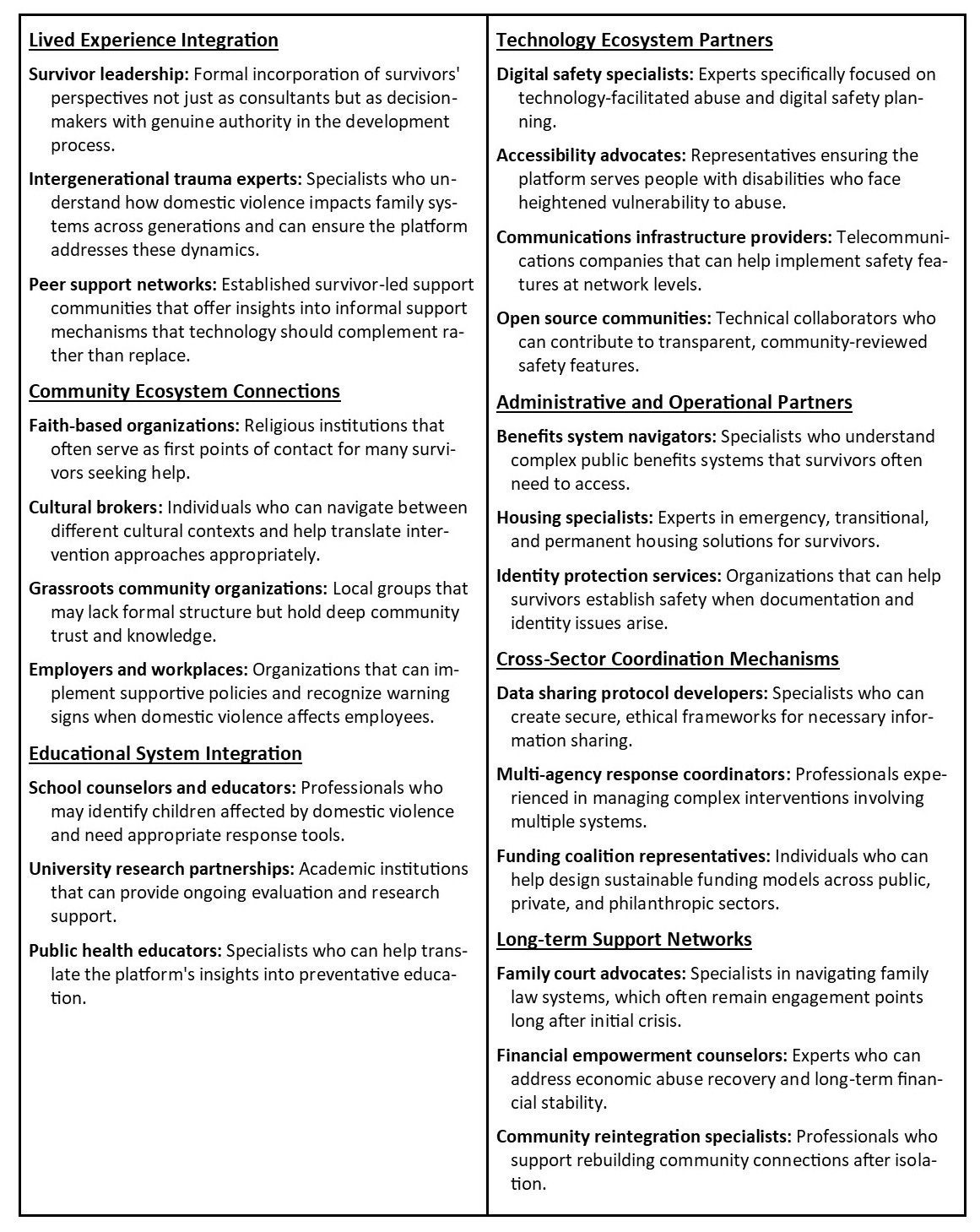
This initiative highlights connections across multiple disciplines. Creating formal mechanisms for these diverse stakeholders to genuinely co-own the development process—beyond mere consultation—is essential for building a platform that truly serves the complex needs of domestic violence survivors while addressing the multifaceted nature of abuse dynamics. Integration across these disciplines requires:
• Cross-functional development teams
• Interdisciplinary training programs
• Shared conceptual frameworks
• Collaborative research initiatives
•Integrated policy development
Implementation Roadmap
Successful implementation requires not just technical excellence but deep attention to power dynamics, trauma impacts, cultural contexts, and sustainability challenges. This comprehensive perspective increases the likelihood of creating a system that genuinely serves survivor needs while avoiding potential harms. A practical implementation roadmap would include:

Phase 1: Foundation (0-6 months)
Establish multi-stakeholder steering committee
Conduct comprehensive needs assessment
Develop ethical framework and governance structure
Secure initial funding for pilot development
Begin data sharing agreement negotiations
Initiate technology partner selection
Survivor leadership integration
Community readiness assessment
Trauma-informed design principles
Safety protocol development
Historical intervention analysis
Cross-disciplinary translation framework
Phase 2: Development (6-12 months)
Create initial AI models with available data
Develop secure technical infrastructure
Design stakeholder interfaces and integration points
Establish evaluation metrics and baseline data
Complete governance structure implementation
Begin stakeholder training development
Adversarial testing team
Scenario-based development
Ethical circuit breakers
Alternative access pathways
Cultural adaptation framework
Non-digital backup systems
Phase 3: Pilot Implementation (12-18 months)
Deploy limited system in controlled environment
Implement intensive monitoring protocols
Conduct iterative improvement cycles
Document lessons learned and system refinements
Begin initial outcome evaluation
Develop expansion strategy based on pilot results
Shadow testing period
Staged risk implementation
Contextual variation testing
Real-Time adaptation mechanisms
Cross-system communication audits
False positive/negative analysis
Phase 4: Expansion (18-36 months)
Geographic and stakeholder expansion
Full integration with existing systems
Comprehensive training program deployment
Community awareness campaign implementation
Long-term funding structure development
Continuous improvement process establishment
Inter-jurisdiction coordination frameworks
Knowledge repository development
Resistance management strategy
Technology transfer methodology
Secondary trauma support systems
Digital divide mitigation
Phase 5: Sustainability (36+ months)
Complete system evaluation
Research publication and knowledge sharing
Technology refresh planning
Model refinement and expansion
Expansion to additional use cases
Long-term impact assessment
Ethical obsolescence planning
Ownership transition strategy
Cross-generation knowledge transfer
Policy integration initiative
Prevention integration
Historical documentation
Overarching:
Critical Cross-Phase Implementation Considerations
1. Parallel Process Tracks
Implement parallel development tracks with different focuses:
Technical system development
Community capacity building
Institutional relationship nurturing
Policy environment development
Culture change facilitation
2. Embedded Reflection Points
Schedule mandatory reflection periods (not just evaluations) where development pauses for deep assessment:
Mid-phase reflection points
Cross-disciplinary sense-making sessions
Formal expectation adjustment processes
3. Active Accountability Structures
Move beyond passive oversight to active accountability:
Regular public reporting on progress and challenges
Independent ethics reviews at key milestones
Transparent failure documentation and learning
4. Multi-Level Skill Development
Address skill gaps at multiple levels simultaneously:
Technical team members gaining domain expertise
Domain experts developing technical literacy
Leadership developing cross-boundary management skills
Community participants developing system engagement capabilities
5. Trauma-Informed Timeline Management
Recognize that trauma-informed work requires different timing considerations:
Buffer periods built into all deadlines
Explicit recognition of emotional labor costs
Scheduled recovery periods for teams
Realistic timelines that acknowledge relationship-building requirements
Key Indicators of Readiness Between Phases
From Foundation to Development
Survivor leadership fully integrated and functional
Ethical framework tested against edge cases
Cross-disciplinary teams demonstrating effective communication
Initial data mapping reveals no critical gaps
From Development to Pilot
Adversarial testing reveals manageable risk level
Training materials demonstrate accessibility across stakeholder groups
All critical safety protocols validated
System response to edge cases meets expert expectations
From Pilot to Expansion
Clear evidence of system value to survivors
No significant unintended consequences identified
Integration points functioning with minimal friction
Cost-benefit analysis supports expansion
From Expansion to Sustainability
Community ownership increasing
System demonstrating adaptability to changing conditions
Evidence of reduced demand on crisis services
Stable funding model established
Leveraging AI in Additional Domestic Violence Programs
Beyond the core detection and intervention system, AI can support additional domestic violence programs.
Prevention Programs
Relationship health assessment tools
Educational intervention targeting through predictive analytics
Community risk mapping for resource allocation
Early warning systems for youth dating violence
Victim Support
Personalized safety planning that evolves with changing circumstances
AI-moderated peer support communities
Resource recommendation engines based on individual circumstances
System Improvement
Service gap identification through data analysis
Policy effectiveness evaluation
Resource allocation optimization
Outcome prediction for different intervention approaches
Offender Management
Recidivism risk assessment
Rehabilitation program matching
Compliance monitoring systems
Early intervention for rehabilitation compliance issues
Research Advancement
Pattern identification across large datasets
Effectiveness comparison between intervention methods
Identification of previously unrecognized risk factors
Long-term outcome tracking and analysis
The Next Chapter
In Chapter 4 we have created four worksheets to evaluate such an AI-supported system, which, at this time is purely hypothetical. Should such a system be created, these assets would be helpful monitoring tools to guide its improvements and its mission viability.